Flávio Cerqueira and the Margins of an Entire World
Essay for exhibition catalogue • CCBB Centro Cultural Banco do Brasil
Flávio Cerqueira, um Escultor de Significados • curated by Lilia Moritz Schwarcz
Flávio Cerqueira, um Escultor de Significados • curated by Lilia Moritz Schwarcz
(available in Portuguese)
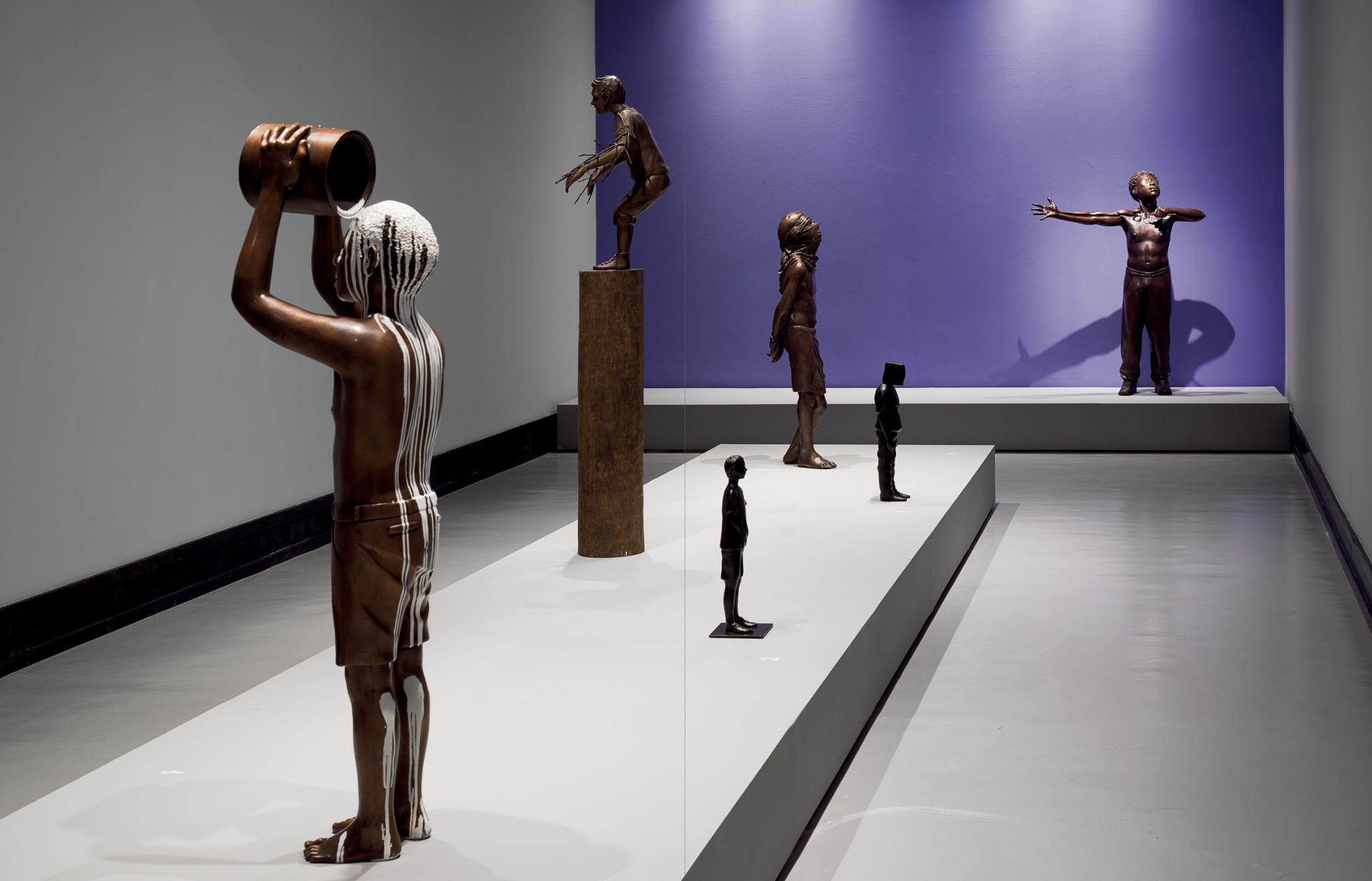
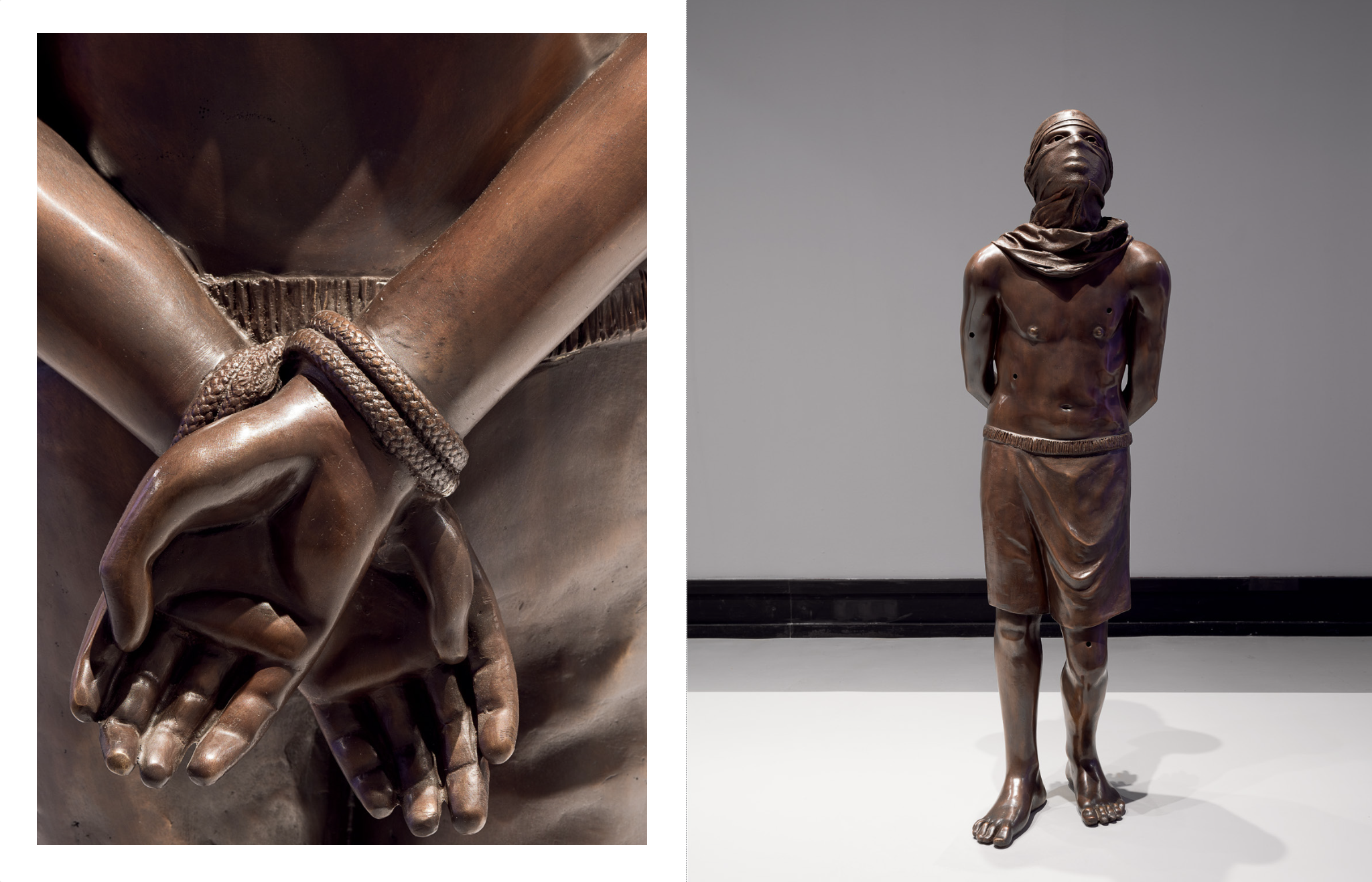
The potential for engagement contained in Flávio Cerqueira’s sculptures seems indisputable. It would be hard to find someone who has visited the Museu de Arte de São Paulo (MASP) in recent years and does not remember the iconic sculpture of the Black boy pouring a bucket of white paint over himself. ¹ It serves as an almost infallible key to recognizing the artist when name and surname are not enough. The sculpture of a boy contemplating his image in a mirror – which is part of the permanent collection of another of São Paulo’s most popular museums, Pinacoteca –, is another example of a work that elicits great public attention and interaction.² Another piece that prompts strong responses is Tião [Sebastian] (2017), that of a boy with his wrists tied behind his back with a rope, barefoot, his head covered by the shirt missing from his torso and his chest exposed with multiple bullet holes. Although people with different experiences would clearly establish varied readings, with their own nuances, it is unlikely that any Brazilian citizen would require additional context in order to elaborate a reading of this work the instant they come across it.
![]()
Regarding the moment of encounter between the work and the viewer, the scenes portrayed by Flávio emphasize precisely this quality of an instant. Unlike so many ancient and classical sculptures that seem posed, Flávio’s capture something closer to Henri Cartier-Bresson’s decisive moment, as if they were the fragment of an action that, frozen in time, resonates its context and its meanings with great intensity and aesthetic appeal. In Flávio’s language, these moments are called “flagrantes,” as in ‘caught in the act’, and, in his hands, they are fixed in the permanence of bronze.
In Brazil, bronze sculpture was introduced by the Portuguese colonization and became widespread from the Imperial period onwards, carrying a direct association with the colonial notion of power. Its durability epitomizes the power imbalance in the arbitrary preservation of certain versions of our history – whose stories are retained and passed on? This reflection comes into play in Flávio’s creations, in which the use of the material, deemed fine, contrasts with contemporary indicators of race and class permeating his work.
The contrast with European references also surfaced during the artist’s formative years when he came to realize the limitation, however temporary, of having cast his attention only outwards, on European sculpture, which he kept as the main reference and influence during the seminal years of his practice’s development. Michelangelo, Gian Lorenzo Bernini, Auguste Rodin, Alberto Giacometti, Louise Bourgeois and Juan Muñoz are some of the artists who influenced Flávio and for whom he built a gravestone in the installation Nós que aqui estamos por vós esperamos [Those of Us Who Are Here Are Waiting For You] (2011), a work that reflects on this European influence and marks the beginning of a gradual process of critical reflection on heritage and cultural erasure.³ Flávio’s critical outlook, proven in his declared interest in seeking a deeper understanding of the history of sculpture production in Brazil, becomes visible in his works when he begins to showcase the bronze, embracing the contrast with his representations and what it suggests. Previously, Flávio had used bronze attracted by its durability, yet covered in paint for a more fragile appearance.
Among other choices that define his style, two formal features can be observed in contrast: on the one hand, the artist deliberately avoids real scale in his figurative human representations; on the other, he prioritizes the representation of young people. The difference in scale is intended to remind the viewer of the work’s fictional aspect: they look human, they represent humans, but they are not. Featuring young people, who essentially fall between childhood and maturity, in turn, maintains a component of ambiguity in the works. As in so many in-between spaces, with blurred boundaries the possibilities of interpretation gets expanded and, suddenly, both an adult and a child can see a bit of themselves in them. Along with this, another artistic decision is consolidated: to keep the sculptures, to an extent, impersonal. Though he uses models to capture the movements and expressions that shape his sculptures, Flávio takes care to redesign their faces in the modeling process.
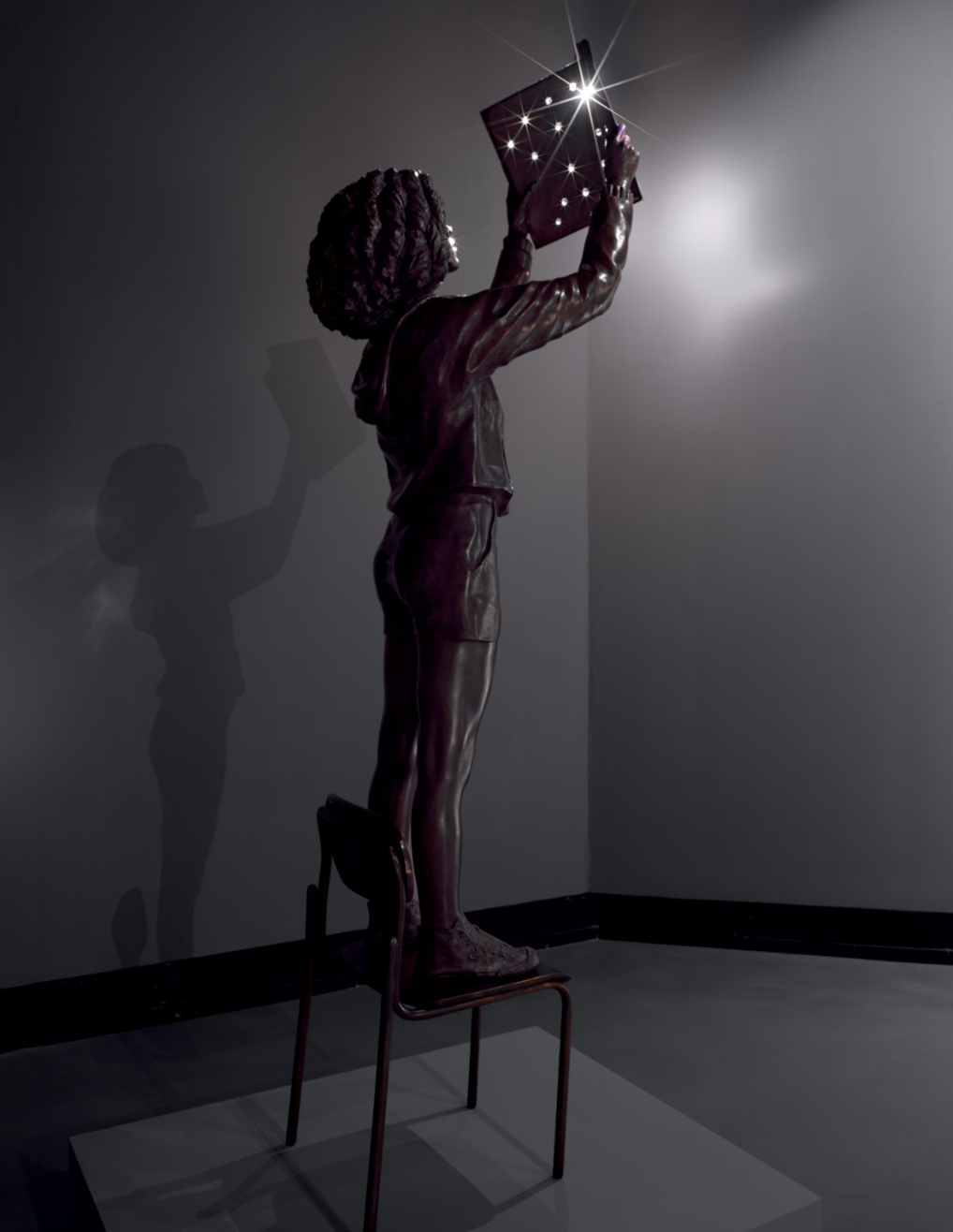
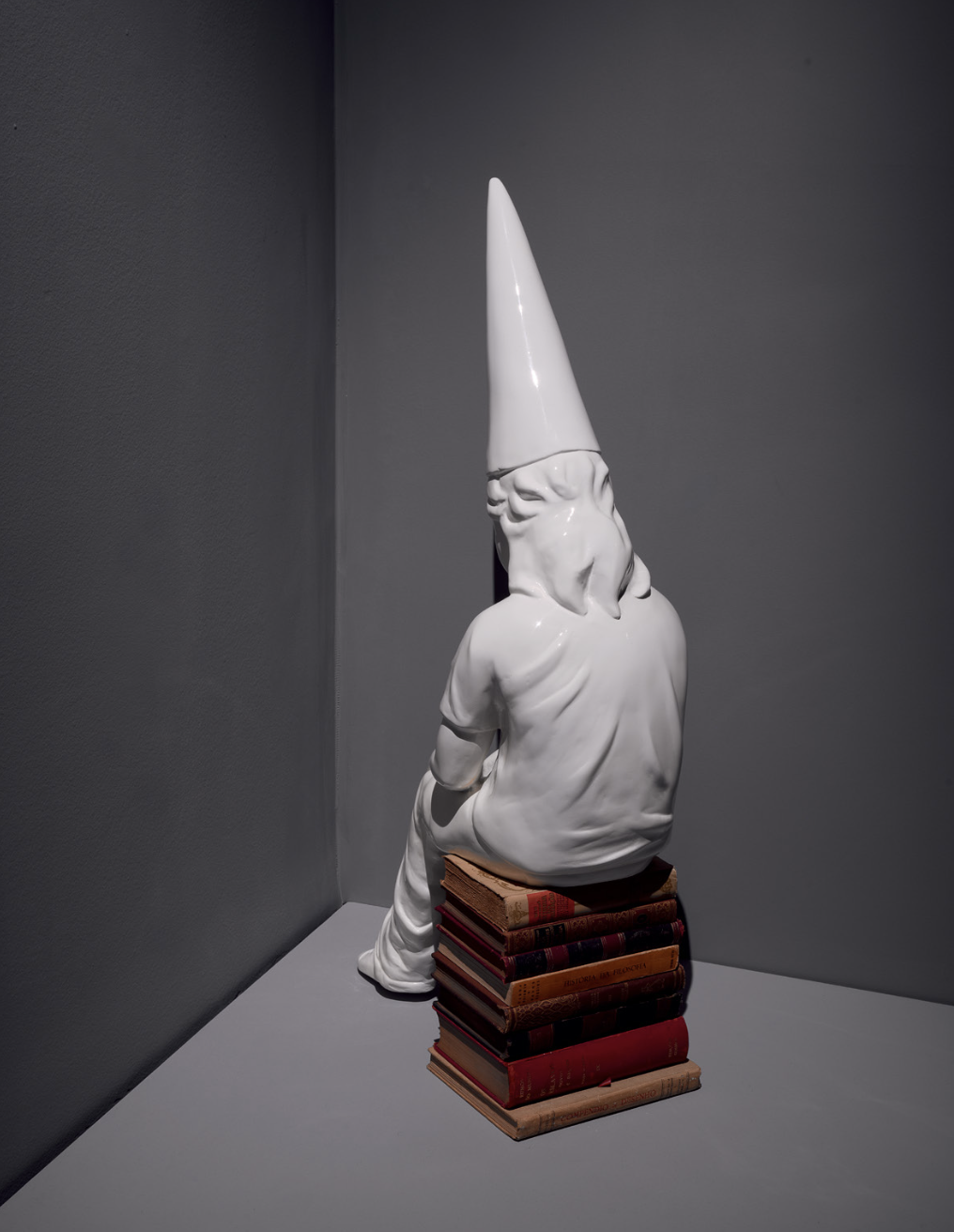
In the durability of bronze, in the moments caught in the act, or in the youth depicted, Flávio’s artistic production addresses ideas of permanence and mobility. In it, the youth portrayed ultimately consolidates an allegory of displacement and transience which is pertinent to addressing issues of exclusion and belonging (or the search for it). There is a literal displacement when the boy is positioned facing the wall, excluded, wearing a dunce’s hat in Foi assim que me ensinaram [This is the How They Taught Me] (2011); or an intention of mobility demonstrated when a boy sails over tree trunks with his gaze directed upward and forward in Logo ali [Right There] (2014); or when another boy prepares to take flight with wooden wings attached to his arms in Avua! [Fly!] (2013). Another form of displacement is the sense of projection contained in No meu céu ainda brilham estrelas [In My Sky Stars Still Shine] (2023), in the movement of a body that positions itself as high as possible, their feet on the seat of a chair, pointing a book up at the sky to see stars through it. The quest for mobility evident in some of the works transcends physical connotations when it is occasionally crossed by indicators of class.
![]()
![]()
![]()
Flávio claims to be “formed,” as in trained, “by the work itself.” This can be taken to mean that he learned by doing. In other words, instead of educational training as the primary starting point (although he did acquire it), what most influenced his development was the practice of climbing the ranks little by little, through the gaps, making his way off the more conventional paths. One can also think of the term “form” in the literal sense, which is directly related to the artist’s craft: the casting form that positions the boundaries between work and surroundings, a mold that acts as a boundary layer, the edge of an entire world. The very practice of sculpting is, in turn, a constant exercise of negotiating contours, of what belongs and what is left out. Along with the notions of displacement and mobility, the concept of margins is thus present in the artist’s work as much as in his life context.
The way in which Flávio’s environment shapes his work has a practical dimension too. The size of his sculptures has expanded as his workspaces have scaled up over the course of his career, moving from a simple room in his home gradually up to his current, spacious studio in São Paulo’s city center. Such evolution is as remarkable as the intricacy of details in his sculptures – body expressions and hair textures, for example – which have become more elaborate over time, as has his overall structure for working. From the space that surrounds him also emerge recognizable social signs that assign him a particular place on the map of privileges of São Paulo’s society. Flávio grew up in the Pimentas neighborhood, which, located on the outskirts of Guarulhos and bordering São Paulo along the Tietê River, is like the margin of the margin, in the complex metropolitan landscape that, too, has come to form him.
![]()
Whether intentionally or not, his sculptures give some of this away. The hair texture or certain facial features at times indicate the color of the skin these figures would have had were they not made of bronze. The simple clothing and body posture – often grandiose and dreamy, but also bearing an air of simplicity – offer the possibility of an identification that, beyond indicating race, although it may sometimes also do so, it indicates a socio-economic class – one of few privileges. The sculptures depict bare feet and shirtless torsos, curly hair, baggy shorts, flip-flops. It is as if these aesthetic elements, though never absolute determinants, serve as points of access for interpretation, which to some extent (and with varying distances) is also a process of recognition. Through them one can read Flávio’s work and, at the same time, trace part of his origin and trajectory.
Two other features can be considered points of access in Flávio’s work. One of them, quite literal, is the embedding of real objects in the sculptures. In Cansei de aceitar assim [Tired of Accepting That] (2020), a girl wearing short, tight clothes leans against a real traffic sign with the instruction STOP; in Eu te disse… [I Told You…] (2016), books bury a body lying on the ground of which only the feet are visible; a wooden stool raises the viewpoint in Horizonte infinito [Infinite Horizon] (2013); and a mirror is faced in the work at Pinacoteca, Antes que eu me esqueça [Before I Forget Myself] (2013). Rather than belonging to Flávio’s characters, the objects in these works belong first to the everyday world, to common environments, and are generally familiar items. By bringing this contemporary, everyday universe into the sculpture, an active effort is made to build bridges between reality and fiction, between the work and the viewer. Work’s titles can be perceived in the same way, as many of them have a strong commonplace narrative appeal: No One Can Bring Me Down, Loves Me Not, Infinite Horizon, A Pretext to See You, In Memory of Me, To Be Myself Again, Power. They display a degree of indetermination that is well described by another of his titles: About Everything, But Not About Anything.
Sometimes direct, sometimes very subtle, Flávio’s sculptures contain suggestions. They can be found in their body language and clothing, in the artist’s choice to incorporate mundane objects, or in his titles’ compelling statements. Upon encountering the viewer, these suggestions hold space for the establishment of relationships. In this sense, the sculptures are extremely successful in the condition of what philosopher Umberto Eco defines as an “open work:” intentionally incomplete in the sense that it carries such a capacity for interpretation that it is ultimately finalized only in front of the viewer (who, according to Eco, by receiving and interpreting it, also ends up performing it; and the work thus ends up being constituted differently upon each reception).
Of course, this does not make Flávio’s pieces works in progress per se. With the exception of the case in which the artist leaves the carving knife in the sculpture’s hand, in Desenho cego [Blind Drawing] (2024), it would be difficult to think of a bronze sculpture as something unfinished, and even more difficult to take to heart the proposition of a static sculpture as performance: it is clear that Flávio’s work carries meanings predetermined by him – and many of them are rather literal. But the condition defined by Eco can be applied to the interpretation of Flavio’s production in the sense that each reception of the work ends up incorporating a renewed perspective of itself, since it comes from those who receive it – which, in Flavio’s case, happens with great effectiveness due to the potential of the works themselves to stimulate the imagination and emotions of the observer with sufficient depth for such.
In this case, what makes them hold such potential is that, by leaving suggested points of access in the works while maintaining a considerable dose of vagueness or ambiguity, what Flávio does is negotiate identification with non-identification, commonplace with non-determination, reserving a generous space in the work for the beholder. Desenho cego [Blind Drawing] is a great example of how ambiguity expands the possibilities of interpretation, where the carving knife on top of the material signals creation, just as its proximity to the jugular vein can allude to an attempt on one’s life. In this, as in so many other works, the vagueness that occasionally punctuates the work facilitates a process of identification on the part of the viewer. And, in the same way as youth is positioned on the blurred boundaries of transience, the non-personalization of facial representations adopts the same strategy: his sculptures’ faces (which are redesigned so as to be nobody specifically), in being nobody, more easily become a bit of everybody. This negotiation once again conjures the idea of a margin: that which is essentially ambiguous and ultimately a fine line, that part of being that is closer to what it is not.
However, if it is clear that the artist actively seeks to stimulate a process of recognition through these many points of access explicitly inserted in his work, it may seem contradictory that not only does he avoid their personalization (as noted and justified) but he also seems to keep a distance from identity discourses. Consider, for example, how Flávio humorously recounts that it was the sculptor and curator Emanoel Araujo (1940-2022) – who, as the director of Museu Afro Brasil, would acquire his work Passarinho [Little Bird] (2013) for the museum’s collection in 2014 – who informed him that “Pardo is Black!” ⁶ in response to the artist’s faltering attempt at self-identification. Flávio is somewhat skeptical of the way identity politics have been dealt with in the art world, at times positioning people too hastily into forms (molds!) – the Black, the poor, or the one who is in any given instance marginal to the center (whatever that center may be). Flávio does not deny his origins, but he carries with him the confidence of someone who knows that his identity as an artist is not defined there, in any of those molds. Questioned as to who he represents, his answer is swift and uncomplicated: “The people around me.” There you have it, the margins playing a role in this story again.
In fact, although certain identity features are reflected in the work, present and easily identifiable, it would be unfair to say that the excellence of Flávio’s work is defined by this. Consider the works initially mentioned: it is not just Black people who find the sculpture at MASP memorable, it is not just teenagers who photograph themselves in the mirror of the work at Pinacoteca, and it is certainly not just people from the periphery of São Paulo who feel in their chests the plight of Tião, who was shot. Flávio’s works connect with the subjectivity of a much wider group of people.
At this point, it is worth returning to Flavio’s stated European references to observe an important parallel with one of his most surprising influences: Alberto Giacometti. For although they both represent human figures, they do so with very different visual identities, as well as historical, social and geopolitical contexts (Giacometti, a Swiss sculptor who produced his art in the context of the World Wars and who, exactly 100 years ago, lived in Paris). But there is something more fundamental in common between them. Giacometti was deeply afflicted by the fear of death from an early age and, as he perfected his representations of elongated and slender figures (later on, in the postwar period), he reflected on human conditions of isolation and fragility. What Giacometti captured with such excellence in his sculptures was the essence of human vulnerability. And this is precisely where he and Flávio Cerqueira meet, despite a century and an ocean of distances.
Flávio’s works touch the viewer so effectively because, rather than speaking to specific identity groups – though they also do so – they capture vulnerability in an intensity that resonates with essential, profound, and timeless aspects of the human condition. In this sense, even though Flávio does not portray himself or other specific individuals, who he represents does not seem to be the other either, in the sense of someone from whom one keeps a distance and in whom one sees differences. Flávio’s representations, on the contrary, seem to portray those in whom it is possible to see oneself, and for whom, in doing so, one can feel as oneself.
![]()
_
Notes:
1. Amnésia (2015).
2. Antes que eu me esqueça (2013).
3. The installation Nós que aqui estamos por vós esperamos [Those of Us Who Are Here Are Waiting For You] was presented at Carpe Diem Arte Pesquisa, Lisbon, Portugal, 2010.
4. Umberto Eco, The Open Work, trad. Anna Cancogni. Cambridge, MA: Harvard University Press, 1989, p. 4.
5. In the words of Umberto Eco, “An artistic work that suggests is also one that can be performed with the full emotional and imaginative resources of the interpreter”. Op. cit., p. 9.
6. In Brazil, the term “pardo” indicates a mixed-race and/or light-shaded brown person. Its equivalence in the English language would vary according to different local vocabularies. Although the term is employed in official Brazilian Government surveys, in the last decades it has been challenged by Black communities due to political implications related to cultural erasure.
_
Photgraphy:
Romulo Fialdini
_
Exhibition dates:
São Paulo | 7 December 2024 – 17 February 2025
Belo Horizonte | 12 March – 2 June 2025
Brasília | 24 June – 24 August 2025
Rio de Janeiro | 22 October 2025 – 26 January 2026
The potential for engagement contained in Flávio Cerqueira’s sculptures seems indisputable. It would be hard to find someone who has visited the Museu de Arte de São Paulo (MASP) in recent years and does not remember the iconic sculpture of the Black boy pouring a bucket of white paint over himself. ¹ It serves as an almost infallible key to recognizing the artist when name and surname are not enough. The sculpture of a boy contemplating his image in a mirror – which is part of the permanent collection of another of São Paulo’s most popular museums, Pinacoteca –, is another example of a work that elicits great public attention and interaction.² Another piece that prompts strong responses is Tião [Sebastian] (2017), that of a boy with his wrists tied behind his back with a rope, barefoot, his head covered by the shirt missing from his torso and his chest exposed with multiple bullet holes. Although people with different experiences would clearly establish varied readings, with their own nuances, it is unlikely that any Brazilian citizen would require additional context in order to elaborate a reading of this work the instant they come across it.
Regarding the moment of encounter between the work and the viewer, the scenes portrayed by Flávio emphasize precisely this quality of an instant. Unlike so many ancient and classical sculptures that seem posed, Flávio’s capture something closer to Henri Cartier-Bresson’s decisive moment, as if they were the fragment of an action that, frozen in time, resonates its context and its meanings with great intensity and aesthetic appeal. In Flávio’s language, these moments are called “flagrantes,” as in ‘caught in the act’, and, in his hands, they are fixed in the permanence of bronze.
In Brazil, bronze sculpture was introduced by the Portuguese colonization and became widespread from the Imperial period onwards, carrying a direct association with the colonial notion of power. Its durability epitomizes the power imbalance in the arbitrary preservation of certain versions of our history – whose stories are retained and passed on? This reflection comes into play in Flávio’s creations, in which the use of the material, deemed fine, contrasts with contemporary indicators of race and class permeating his work.
The contrast with European references also surfaced during the artist’s formative years when he came to realize the limitation, however temporary, of having cast his attention only outwards, on European sculpture, which he kept as the main reference and influence during the seminal years of his practice’s development. Michelangelo, Gian Lorenzo Bernini, Auguste Rodin, Alberto Giacometti, Louise Bourgeois and Juan Muñoz are some of the artists who influenced Flávio and for whom he built a gravestone in the installation Nós que aqui estamos por vós esperamos [Those of Us Who Are Here Are Waiting For You] (2011), a work that reflects on this European influence and marks the beginning of a gradual process of critical reflection on heritage and cultural erasure.³ Flávio’s critical outlook, proven in his declared interest in seeking a deeper understanding of the history of sculpture production in Brazil, becomes visible in his works when he begins to showcase the bronze, embracing the contrast with his representations and what it suggests. Previously, Flávio had used bronze attracted by its durability, yet covered in paint for a more fragile appearance.
Among other choices that define his style, two formal features can be observed in contrast: on the one hand, the artist deliberately avoids real scale in his figurative human representations; on the other, he prioritizes the representation of young people. The difference in scale is intended to remind the viewer of the work’s fictional aspect: they look human, they represent humans, but they are not. Featuring young people, who essentially fall between childhood and maturity, in turn, maintains a component of ambiguity in the works. As in so many in-between spaces, with blurred boundaries the possibilities of interpretation gets expanded and, suddenly, both an adult and a child can see a bit of themselves in them. Along with this, another artistic decision is consolidated: to keep the sculptures, to an extent, impersonal. Though he uses models to capture the movements and expressions that shape his sculptures, Flávio takes care to redesign their faces in the modeling process.
In the durability of bronze, in the moments caught in the act, or in the youth depicted, Flávio’s artistic production addresses ideas of permanence and mobility. In it, the youth portrayed ultimately consolidates an allegory of displacement and transience which is pertinent to addressing issues of exclusion and belonging (or the search for it). There is a literal displacement when the boy is positioned facing the wall, excluded, wearing a dunce’s hat in Foi assim que me ensinaram [This is the How They Taught Me] (2011); or an intention of mobility demonstrated when a boy sails over tree trunks with his gaze directed upward and forward in Logo ali [Right There] (2014); or when another boy prepares to take flight with wooden wings attached to his arms in Avua! [Fly!] (2013). Another form of displacement is the sense of projection contained in No meu céu ainda brilham estrelas [In My Sky Stars Still Shine] (2023), in the movement of a body that positions itself as high as possible, their feet on the seat of a chair, pointing a book up at the sky to see stars through it. The quest for mobility evident in some of the works transcends physical connotations when it is occasionally crossed by indicators of class.
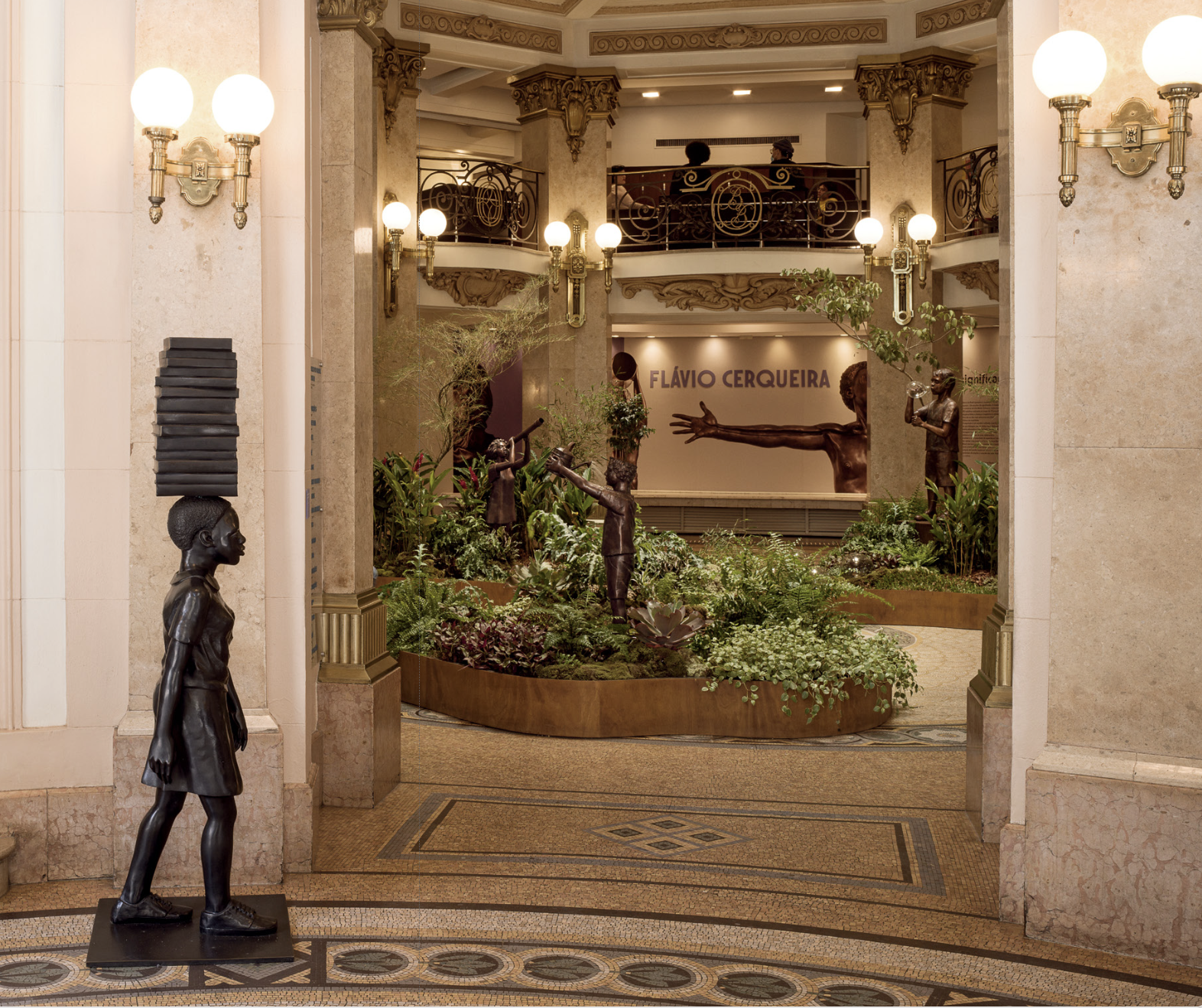
Flávio claims to be “formed,” as in trained, “by the work itself.” This can be taken to mean that he learned by doing. In other words, instead of educational training as the primary starting point (although he did acquire it), what most influenced his development was the practice of climbing the ranks little by little, through the gaps, making his way off the more conventional paths. One can also think of the term “form” in the literal sense, which is directly related to the artist’s craft: the casting form that positions the boundaries between work and surroundings, a mold that acts as a boundary layer, the edge of an entire world. The very practice of sculpting is, in turn, a constant exercise of negotiating contours, of what belongs and what is left out. Along with the notions of displacement and mobility, the concept of margins is thus present in the artist’s work as much as in his life context.
The way in which Flávio’s environment shapes his work has a practical dimension too. The size of his sculptures has expanded as his workspaces have scaled up over the course of his career, moving from a simple room in his home gradually up to his current, spacious studio in São Paulo’s city center. Such evolution is as remarkable as the intricacy of details in his sculptures – body expressions and hair textures, for example – which have become more elaborate over time, as has his overall structure for working. From the space that surrounds him also emerge recognizable social signs that assign him a particular place on the map of privileges of São Paulo’s society. Flávio grew up in the Pimentas neighborhood, which, located on the outskirts of Guarulhos and bordering São Paulo along the Tietê River, is like the margin of the margin, in the complex metropolitan landscape that, too, has come to form him.
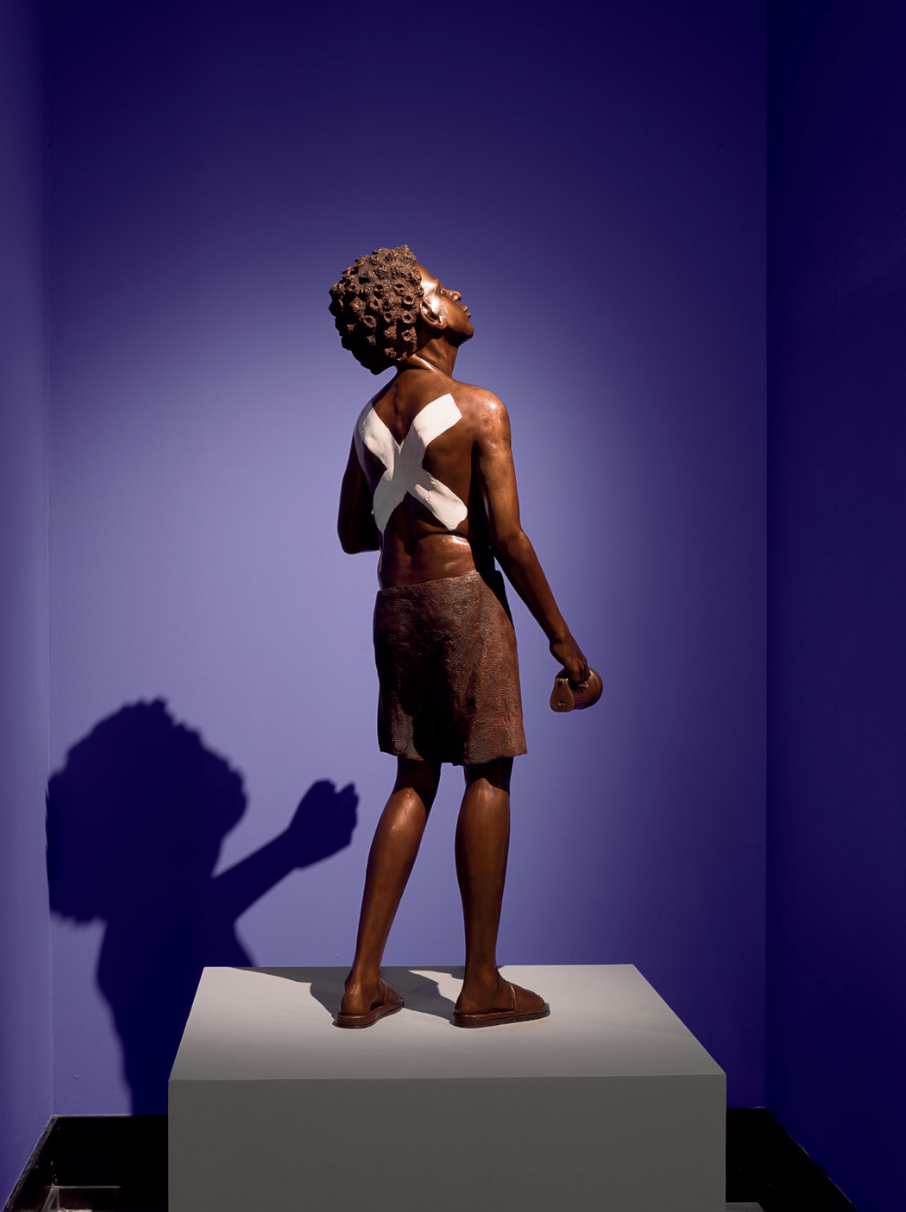
Whether intentionally or not, his sculptures give some of this away. The hair texture or certain facial features at times indicate the color of the skin these figures would have had were they not made of bronze. The simple clothing and body posture – often grandiose and dreamy, but also bearing an air of simplicity – offer the possibility of an identification that, beyond indicating race, although it may sometimes also do so, it indicates a socio-economic class – one of few privileges. The sculptures depict bare feet and shirtless torsos, curly hair, baggy shorts, flip-flops. It is as if these aesthetic elements, though never absolute determinants, serve as points of access for interpretation, which to some extent (and with varying distances) is also a process of recognition. Through them one can read Flávio’s work and, at the same time, trace part of his origin and trajectory.
Two other features can be considered points of access in Flávio’s work. One of them, quite literal, is the embedding of real objects in the sculptures. In Cansei de aceitar assim [Tired of Accepting That] (2020), a girl wearing short, tight clothes leans against a real traffic sign with the instruction STOP; in Eu te disse… [I Told You…] (2016), books bury a body lying on the ground of which only the feet are visible; a wooden stool raises the viewpoint in Horizonte infinito [Infinite Horizon] (2013); and a mirror is faced in the work at Pinacoteca, Antes que eu me esqueça [Before I Forget Myself] (2013). Rather than belonging to Flávio’s characters, the objects in these works belong first to the everyday world, to common environments, and are generally familiar items. By bringing this contemporary, everyday universe into the sculpture, an active effort is made to build bridges between reality and fiction, between the work and the viewer. Work’s titles can be perceived in the same way, as many of them have a strong commonplace narrative appeal: No One Can Bring Me Down, Loves Me Not, Infinite Horizon, A Pretext to See You, In Memory of Me, To Be Myself Again, Power. They display a degree of indetermination that is well described by another of his titles: About Everything, But Not About Anything.
Sometimes direct, sometimes very subtle, Flávio’s sculptures contain suggestions. They can be found in their body language and clothing, in the artist’s choice to incorporate mundane objects, or in his titles’ compelling statements. Upon encountering the viewer, these suggestions hold space for the establishment of relationships. In this sense, the sculptures are extremely successful in the condition of what philosopher Umberto Eco defines as an “open work:” intentionally incomplete in the sense that it carries such a capacity for interpretation that it is ultimately finalized only in front of the viewer (who, according to Eco, by receiving and interpreting it, also ends up performing it; and the work thus ends up being constituted differently upon each reception).
Of course, this does not make Flávio’s pieces works in progress per se. With the exception of the case in which the artist leaves the carving knife in the sculpture’s hand, in Desenho cego [Blind Drawing] (2024), it would be difficult to think of a bronze sculpture as something unfinished, and even more difficult to take to heart the proposition of a static sculpture as performance: it is clear that Flávio’s work carries meanings predetermined by him – and many of them are rather literal. But the condition defined by Eco can be applied to the interpretation of Flavio’s production in the sense that each reception of the work ends up incorporating a renewed perspective of itself, since it comes from those who receive it – which, in Flavio’s case, happens with great effectiveness due to the potential of the works themselves to stimulate the imagination and emotions of the observer with sufficient depth for such.
In this case, what makes them hold such potential is that, by leaving suggested points of access in the works while maintaining a considerable dose of vagueness or ambiguity, what Flávio does is negotiate identification with non-identification, commonplace with non-determination, reserving a generous space in the work for the beholder. Desenho cego [Blind Drawing] is a great example of how ambiguity expands the possibilities of interpretation, where the carving knife on top of the material signals creation, just as its proximity to the jugular vein can allude to an attempt on one’s life. In this, as in so many other works, the vagueness that occasionally punctuates the work facilitates a process of identification on the part of the viewer. And, in the same way as youth is positioned on the blurred boundaries of transience, the non-personalization of facial representations adopts the same strategy: his sculptures’ faces (which are redesigned so as to be nobody specifically), in being nobody, more easily become a bit of everybody. This negotiation once again conjures the idea of a margin: that which is essentially ambiguous and ultimately a fine line, that part of being that is closer to what it is not.
However, if it is clear that the artist actively seeks to stimulate a process of recognition through these many points of access explicitly inserted in his work, it may seem contradictory that not only does he avoid their personalization (as noted and justified) but he also seems to keep a distance from identity discourses. Consider, for example, how Flávio humorously recounts that it was the sculptor and curator Emanoel Araujo (1940-2022) – who, as the director of Museu Afro Brasil, would acquire his work Passarinho [Little Bird] (2013) for the museum’s collection in 2014 – who informed him that “Pardo is Black!” ⁶ in response to the artist’s faltering attempt at self-identification. Flávio is somewhat skeptical of the way identity politics have been dealt with in the art world, at times positioning people too hastily into forms (molds!) – the Black, the poor, or the one who is in any given instance marginal to the center (whatever that center may be). Flávio does not deny his origins, but he carries with him the confidence of someone who knows that his identity as an artist is not defined there, in any of those molds. Questioned as to who he represents, his answer is swift and uncomplicated: “The people around me.” There you have it, the margins playing a role in this story again.
In fact, although certain identity features are reflected in the work, present and easily identifiable, it would be unfair to say that the excellence of Flávio’s work is defined by this. Consider the works initially mentioned: it is not just Black people who find the sculpture at MASP memorable, it is not just teenagers who photograph themselves in the mirror of the work at Pinacoteca, and it is certainly not just people from the periphery of São Paulo who feel in their chests the plight of Tião, who was shot. Flávio’s works connect with the subjectivity of a much wider group of people.
At this point, it is worth returning to Flavio’s stated European references to observe an important parallel with one of his most surprising influences: Alberto Giacometti. For although they both represent human figures, they do so with very different visual identities, as well as historical, social and geopolitical contexts (Giacometti, a Swiss sculptor who produced his art in the context of the World Wars and who, exactly 100 years ago, lived in Paris). But there is something more fundamental in common between them. Giacometti was deeply afflicted by the fear of death from an early age and, as he perfected his representations of elongated and slender figures (later on, in the postwar period), he reflected on human conditions of isolation and fragility. What Giacometti captured with such excellence in his sculptures was the essence of human vulnerability. And this is precisely where he and Flávio Cerqueira meet, despite a century and an ocean of distances.
Flávio’s works touch the viewer so effectively because, rather than speaking to specific identity groups – though they also do so – they capture vulnerability in an intensity that resonates with essential, profound, and timeless aspects of the human condition. In this sense, even though Flávio does not portray himself or other specific individuals, who he represents does not seem to be the other either, in the sense of someone from whom one keeps a distance and in whom one sees differences. Flávio’s representations, on the contrary, seem to portray those in whom it is possible to see oneself, and for whom, in doing so, one can feel as oneself.

_
Notes:
1. Amnésia (2015).
2. Antes que eu me esqueça (2013).
3. The installation Nós que aqui estamos por vós esperamos [Those of Us Who Are Here Are Waiting For You] was presented at Carpe Diem Arte Pesquisa, Lisbon, Portugal, 2010.
4. Umberto Eco, The Open Work, trad. Anna Cancogni. Cambridge, MA: Harvard University Press, 1989, p. 4.
5. In the words of Umberto Eco, “An artistic work that suggests is also one that can be performed with the full emotional and imaginative resources of the interpreter”. Op. cit., p. 9.
6. In Brazil, the term “pardo” indicates a mixed-race and/or light-shaded brown person. Its equivalence in the English language would vary according to different local vocabularies. Although the term is employed in official Brazilian Government surveys, in the last decades it has been challenged by Black communities due to political implications related to cultural erasure.
_
Photgraphy:
Romulo Fialdini
_
Exhibition dates:
São Paulo | 7 December 2024 – 17 February 2025
Belo Horizonte | 12 March – 2 June 2025
Brasília | 24 June – 24 August 2025
Rio de Janeiro | 22 October 2025 – 26 January 2026